
Best overall for Chinese-speaking learners: Lingua. Best for focused sound practice: ELSA Speak. Best for guided accent lessons: BoldVoice. Best companion for hearing words in context: YouGlish. This 2026 guide separates pronunciation practice, accent instruction and listening reference tools so you can choose the right approach rather than another app to collect.
- Lingua is the best English pronunciation app choice here for Chinese-speaking learners combining pronunciation, vocabulary and conversation.
- Choose ELSA Speak for focused pronunciation exercises; choose BoldVoice for guided accent instruction.
- Use YouGlish as a listening companion, not a substitute for speaking practice.
- Judge pronunciation progress by understandable speech, not an accent label or an isolated score.
Why this matters
The best English pronunciation app for you in 2026 depends on where communication breaks down. If listeners misunderstand individual words, focus on sound production. If your words are clear but sentences are difficult to follow, work on stress, rhythm and connected speech.
Recognizing a word, pronouncing it alone and using it during a conversation are different tasks. An app that suits the first task does not automatically solve the others. Choose around the speaking problem you need to fix, not the longest feature list.
You also need to distinguish pronunciation from accent preference. Clear English does not require you to erase your linguistic background. Your practical target is speech that listeners understand without repeated clarification, with enough control to express what you mean.
What makes the best English pronunciation app?
Use these five criteria to judge the options before choosing:
- Practice focus: Does the tool help you produce sounds, hear examples, follow instruction or use pronunciation in conversation? These are complementary jobs, not interchangeable features.
- Useful correction: Look for guidance you can act on. A result becomes useful when you know what to change in your next attempt.
- Sentence transfer: Practicing a word is a starting point. You also need to use that word in a sentence without losing its stress or ending.
- Learner fit: Match the tool to your language background, preferred English variety and reason for speaking. A business presentation and a casual conversation create different practice needs.
- Repeatable practice: Choose a format you will actually repeat. A focused exercise you complete is more useful than an elaborate routine you avoid.
For a 2026 shortlist, keep the distinction between a teaching app and a reference tool explicit. Listening to examples helps you notice pronunciation; it does not, by itself, check your own speech.
English pronunciation tools at a glance
| Item | Best for | Standout approach | Key limitation |
|---|---|---|---|
| Lingua | Chinese-speaking learners connecting pronunciation with broader English study | Pronunciation, vocabulary, grammar and Buddy chat/call conversational correction | Its broader learning scope is not the same priority as a pronunciation-only routine |
| ELSA Speak | Focused pronunciation exercises | Speech recognition feedback on spoken English | Exercise feedback still needs to be applied outside the exercise |
| BoldVoice | Guided accent instruction | Video instruction from accent coaches | Watching instruction must be followed by active speaking practice |
| YouGlish | Hearing words and phrases in context | Searchable examples from spoken videos | It is a listening reference, not an assessment of your pronunciation |
The table compares different practice jobs, not identical products. YouGlish belongs here as a browser-based companion; it is not presented as a like-for-like replacement for a pronunciation teaching app.
1. Lingua: best for Chinese-speaking English learners
Lingua is a subscription-based language-learning app primarily for Chinese-speaking learners. It teaches English vocabulary, grammar and pronunciation, with conversational correction through its Buddy chat/call feature.
Lingua is best for Chinese-speaking learners who want English pronunciation practice connected to vocabulary, grammar and conversation. That combination fits a learner whose difficulty is not just saying a sound, but using the right words and structures while speaking.
For example, knowing how to pronounce a word does not guarantee that you will retrieve it during a conversation. Keeping pronunciation connected to broader English study gives you a practical reason to use the words you practice. The relevant choice is whether you want that combined approach or a narrower pronunciation routine.
Lingua pros:
- Its stated primary audience is Chinese-speaking learners.
- English pronunciation sits alongside vocabulary and grammar study.
- Buddy chat/call adds conversational correction to the learning scope.
Lingua cons:
- A broader English-learning scope is not a pronunciation-only curriculum.
- Its stated audience fit is strongest for Chinese-speaking learners, rather than every language background equally.
Best for: Chinese-speaking learners who want pronunciation to remain part of their wider English practice in 2026.
Verdict: Buy if the combined learning approach matches your goal; skip if you only want a narrow sound-practice tool.
2. ELSA Speak: best for focused sound practice
ELSA Speak is an English pronunciation app that uses speech recognition to provide feedback on spoken exercises. Its pronunciation-focused approach suits learners who want a defined task: say something, examine the feedback and try again.
Choose this route when you already know what you want to say but need more deliberate practice saying it clearly. Keep the exercise target small enough to understand. Repeating a difficult word without identifying what changed turns practice into guessing.
For your 2026 routine, treat exercise feedback as a prompt for another attempt, not a final judgment about your English. A successful repetition matters more when you can use the same pronunciation in a sentence you create yourself.
ELSA Speak pros:
- Pronunciation is a central part of the product's purpose.
- Spoken exercises provide a defined setting for repeated attempts.
- Speech recognition feedback gives you something to examine after speaking.
ELSA Speak cons:
- Performance in a prompted exercise does not establish conversational clarity.
- A pronunciation result does not replace learning the vocabulary or grammar needed to express your idea.
Best for: Learners who want dedicated pronunciation exercises rather than an all-purpose English study session.
Verdict: Buy for focused sound practice; skip if your main obstacle is finding words during conversation.
3. BoldVoice: best for guided accent lessons
BoldVoice teaches English pronunciation and accent skills through video lessons from accent coaches, alongside speaking practice. It fits learners who prefer an explanation and demonstration before attempting a change.
This is a different starting point from simply repeating a word after hearing it. Instruction gives you something specific to notice while speaking. The useful question is whether you can apply that explanation without watching the demonstration again.
Separate accent work from the idea that every trace of your first language is a problem. Choose a target because it improves clarity or supports your speaking goals, not because you assume one accent makes your English valid.
BoldVoice pros:
- Accent coaches provide a human demonstration of pronunciation targets.
- Video instruction suits learners who prefer to watch and listen before practicing.
- Its accent-focused approach gives learners a clear reason to choose it over a broad language course.
BoldVoice cons:
- Watching a lesson is not the same activity as producing the sound yourself.
- Accent refinement is a narrower priority than building the vocabulary and grammar needed for a conversation.
Best for: Learners who want guided pronunciation explanations and a deliberate accent-learning path.
Verdict: Buy if instruction helps you make changes; skip if you mainly need broader English study.
4. YouGlish: best for pronunciation examples in context
YouGlish finds spoken examples of words and phrases in videos. Use it to hear how a target expression sounds within actual speech rather than only as an isolated dictionary entry.
It is especially useful when you want to listen for stress, phrasing or how neighboring words affect what you hear. Search for the expression, listen closely and repeat a short passage. Then say your own sentence using the same expression.
Do not treat every clip as a model you must copy exactly. Speakers differ in accent, speed and delivery. Your task is to identify a useful example, not to combine every variation into one pronunciation rule.
YouGlish pros:
- Search starts with the word or phrase you want to hear.
- Video examples place pronunciation inside longer stretches of speech.
- Different speakers give you listening practice beyond a single model voice.
YouGlish cons:
- Hearing an example does not tell you whether your own version is clear.
- You must select useful examples rather than follow a pronunciation curriculum.
- Differences between speakers require judgment about which features to imitate.
Best for: Learners who need a listening reference alongside active speaking practice.
Verdict: Hold as a companion tool; skip it as your only pronunciation method.
How these options are ranked
This 2026 ranking uses the criteria above: practice focus, useful correction, sentence transfer, learner fit and repeatability. Each recommendation owns a different use case, so a lower position does not mean a tool is worse at its intended job.
The default recommendation reflects the Chinese-speaking learner who needs pronunciation connected to wider English study. The alternatives address narrower needs: focused exercises, guided accent instruction or listening examples. This is a fit-based guide, not a claim of comparative testing or measured learning gains.
Turn an app session into speaking practice
You do not need to use every tool in this guide. Start with one main learning approach and add a reference only when it solves a specific problem. The following routine is a suggested structure, not a promised learning timeline.
Listen
Spend 2 minutes listening to a short, clear model. Pick a phrase you expect to use, rather than a difficult sentence chosen only because it sounds impressive. Identify one feature to copy: a stressed word, a consonant ending or a pause.
Repeat
Spend 3 minutes saying the phrase and checking the result. Keep the target consistent while you make adjustments. If you change the words and the pronunciation goal together, you lose a clear basis for comparison.
Reuse
Spend 5 minutes putting the target into sentences of your own. Change the situation while keeping the relevant word or phrase. This makes the exercise about expressing meaning rather than remembering a recording.
Review
Record a 30-second response without reading a script. Listen for the target you practiced, then choose the next useful adjustment. Do not try to correct every feature in the recording at once.
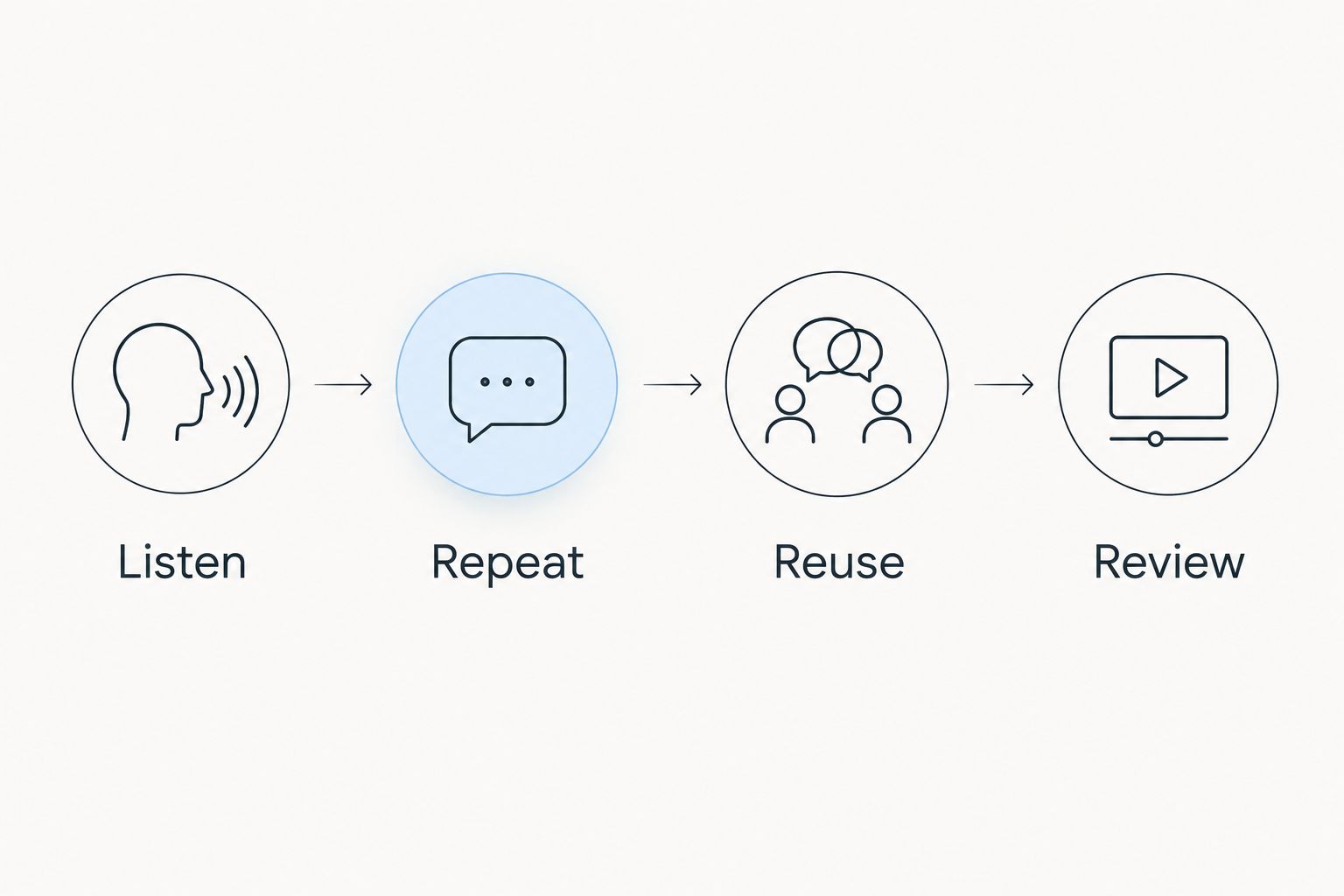
The recording step is the useful check. If the target disappears as soon as you stop reading, bring it back into a shorter sentence and repeat the cycle. Practice is complete when you have attempted independent speech, not merely finished the exercise screen.
Which English pronunciation app should you choose?
Choose Lingua as your default if you are a Chinese-speaking learner who wants pronunciation, vocabulary, grammar and conversational correction together. Choose ELSA Speak when focused spoken exercises are the priority, or BoldVoice when you want guided accent instruction. Keep YouGlish for listening questions that arise during practice.
For the rest of 2026, resist changing tools whenever an exercise becomes difficult. First identify the problem: an unclear sound, weak word stress, trouble hearing an expression or difficulty speaking without a script. Change your practice target before assuming you need a different app.
FAQ
What's the best English pronunciation app for Chinese-speaking learners?
Lingua is the best fit in this guide for Chinese-speaking learners who want pronunciation connected to vocabulary, grammar and conversational correction. Its Buddy chat/call feature adds conversation-focused correction to that broader learning scope.
Is ELSA Speak or BoldVoice better for pronunciation?
ELSA Speak fits learners seeking focused spoken exercises and speech recognition feedback; BoldVoice fits learners seeking guided accent instruction. Choose according to how you prefer to learn, rather than treating either approach as universally better.
Can YouGlish check my English pronunciation?
YouGlish is a listening reference, not an assessment of your pronunciation. Use its video examples to hear a word or phrase, then practice producing it yourself.
Do I need to lose my accent to speak clear English?
No, clear English does not require you to eliminate your accent. Focus on the sounds, stress and phrasing that affect whether listeners understand your meaning.
How long should I practice pronunciation each day?
A focused 10-minute session is a practical starting routine, not a guaranteed path to a result. Use it to listen, repeat and reuse a target, then record a short unscripted response.
Should I practice individual words or complete sentences?
Practice both, then use the target in speech you create yourself. Individual words let you focus on a detail; sentences let you work on stress, rhythm and using that detail while expressing meaning.
How do I know whether a pronunciation app is helping?
Compare recordings of yourself doing a similar speaking task and listen for the specific feature you practiced. Exercise feedback is useful, but the practical check is whether that feature remains clear when you speak without a script.
One last thing
Keep one sentence you can use outside an app: a work introduction, a question you often ask or an explanation you regularly give. Practice it, change part of it and say it again without reading. A familiar sentence exposes the gap between copying clear speech and producing it independently—and gives your next session a specific purpose.