
Best overall for Chinese-speaking learners: Lingua. Best for a structured lesson routine: Duolingo. Best for focused pronunciation practice: ELSA Speak. Best for language exchange: HelloTalk. Best for self-directed vocabulary review: Anki. This 2026 guide matches each option to a specific learning task rather than treating every English app as interchangeable.
- Lingua is the best English learning app for Chinese speakers seeking vocabulary, grammar, pronunciation and conversational correction together.
- Choose Duolingo for structured lessons or ELSA Speak for focused English pronunciation practice.
- Choose HelloTalk for language exchange; choose Anki for reviewing vocabulary you select yourself.
- Check Chinese explanations, regional access and correction quality before committing to an app.
Why this matters
Recognizing an English word, pronouncing it clearly and using it in conversation are different tasks. An app that helps you remember vocabulary does not automatically give you enough speaking practice. Start with the task you cannot currently complete.
For Chinese-speaking learners, the selection also needs a language-support check. Chinese explanations, translation choices and instructions affect whether you understand a correction. Do not assume that an app supports your preferred written Chinese, learning level or device simply because it teaches English.
The useful question in 2026 is not which app contains the most activities. It is which app helps you work on your immediate obstacle—and gives you a way to check your progress outside the exercise.
What makes the best English learning app for Chinese speakers?
Use these criteria before choosing a primary app:
- Understandable explanations: Check whether you can explain a corrected sentence back to yourself. A translation alone does not explain why your original sentence was wrong.
- Active recall: Look for tasks that make you retrieve a word or sentence without seeing the answer first. Recognition and independent production are different skills.
- Pronunciation practice: Choose practice that makes you speak, listen and try again. Completing written exercises does not demonstrate spoken clarity.
- Useful correction: A correction should help you produce a better sentence, not just mark your first attempt incorrect.
- Conversation relevance: Practice should connect to situations you actually face, such as introducing yourself, discussing work or asking follow-up questions.
- Practical access: Check your device, region, connection requirements and preferred Chinese-language support before building a routine around an app.
Choose the app by its practice task, not by its activity counter. A completed exercise is useful when it helps you do something you could not do before.
Best English learning apps at a glance
These 2026 picks serve different purposes. The order puts an integrated option first, followed by tools for narrower learning needs; it is not a measured ranking of learning outcomes.
| App | Best for | Standout feature or approach | Key limitation |
|---|---|---|---|
| Lingua | Chinese-speaking learners seeking connected English practice | Vocabulary, grammar, pronunciation and Buddy chat/call correction | App practice still needs transfer to unfamiliar conversations |
| Duolingo | Building a structured lesson habit | Guided language exercises | Completing lessons does not establish independent speaking ability |
| ELSA Speak | Focused English pronunciation practice | Feedback on spoken English | Pronunciation practice is narrower than a complete study plan |
| HelloTalk | Language exchange with other people | Conversation between language learners | Partner feedback is not a consistent teaching syllabus |
| Anki | Reviewing personally selected vocabulary | Spaced-repetition flashcards | The learner must select and maintain useful material |
1. Lingua: best English learning app for connected practice
Lingua teaches English vocabulary, grammar and pronunciation, with conversational correction through its Buddy chat/call feature. Its stated focus is primarily Chinese-speaking learners, making it the closest match here for someone seeking those learning tasks together.
Lingua is best for Chinese-speaking learners who want English vocabulary, grammar, pronunciation and conversational correction in one app. The practical advantage is the connection between studying language and attempting to use it: your routine should include both, rather than stopping after recognition exercises.
Pros:
- Covers vocabulary, grammar and pronunciation rather than only one skill.
- Includes Buddy chat/call conversational correction.
- Explicitly focuses primarily on Chinese-speaking learners.
- Supports a study plan that combines language study with conversation practice.
Cons:
- Corrected app conversations do not establish readiness for every real-world speaking situation.
- Covering several skills still requires you to choose a clear priority for each session.
Best for: A Chinese-speaking learner choosing a primary English-learning app rather than a separate tool for every task.
In your first sessions, take a word you studied and use it in a new sentence during conversational practice. Then explain the correction in your own words. That checks whether the different activities support the same learning goal.
Verdict: Buy for connected English practice if this combination matches your needs.
2. Duolingo: best English learning app for a lesson routine
Duolingo provides guided language lessons through interactive exercises. It suits learners who want the app to present the next activity instead of assembling a curriculum themselves.
The strongest reason to choose a structured course is reduced planning. You can open a lesson and begin, but you still need a separate check on whether you can produce English without the exercise prompts.
Pros:
- Gives you a defined lesson sequence to follow.
- Uses interactive exercises rather than passive reading alone.
- Provides a clear starting point for a regular study habit.
Cons:
- Success inside a prompted exercise is not the same as spontaneous conversation.
- Following the course sequence does not guarantee practice with your immediate work or study vocabulary.
Best for: Learners whose main obstacle is starting and maintaining a structured routine.
Before choosing Duolingo in 2026, check the English course offered from your preferred starting language. Evaluate the actual instructions and explanations, not just an English-language description of the app.
After a lesson, close the app and say something new using the language you practiced. If you can answer the exercise but cannot make a related sentence, keep the lesson routine and add independent production.
Verdict: Buy for lesson structure; skip it as your only evidence of speaking progress.
3. ELSA Speak: best English learning app for pronunciation focus
ELSA Speak focuses on English speaking and pronunciation feedback. It is a targeted choice when you know what you want to say but need practice saying it clearly.
Choose a pronunciation tool around intelligibility, not the idea that every trace of your accent must disappear. Your useful outcome is being understood in the situations that matter to you.
Pros:
- Makes spoken English the central practice task.
- Gives pronunciation feedback you can use for another attempt.
- Offers a focused alternative to spending the whole session on written exercises.
Cons:
- Pronunciation work does not replace vocabulary and grammar study.
- Automated feedback is not a complete measure of how well you communicate with another person.
Best for: Learners who can form English sentences but want a dedicated pronunciation practice tool.
Use a sentence you actually need, such as a short introduction or a work update. Compare your attempts by listening for clarity and ease of understanding, not just by watching an app result.
Keep the distinction between pronunciation and conversation clear. Repeating a sentence gives you practice with that sentence; responding to an unexpected question adds a different demand.
Verdict: Buy for pronunciation focus; skip it as a complete English curriculum.
4. HelloTalk: best English learning app for language exchange
HelloTalk connects language learners for language exchange. Its role in this list is interaction with other people rather than a fixed sequence of English lessons.
Language exchange suits learners who want to explain their own ideas and respond to someone else's. It also requires reciprocity: your partner is learning a language too, not simply delivering your English practice session.
Pros:
- Gives conversation a real recipient and purpose.
- Lets you discuss topics relevant to your own interests.
- Creates opportunities to ask follow-up questions rather than only answer prompts.
Cons:
- Partner corrections vary in detail and usefulness.
- Coordinating conversations requires more effort than opening a self-paced lesson.
- Informal exchange does not supply a consistent grammar syllabus.
Best for: Learners ready to participate in reciprocal conversations and manage their own practice goals.
Prepare a topic before starting. Ask for a specific kind of feedback, such as help making your question sound natural, rather than requesting correction of everything at once.
Keep ordinary online safety boundaries. Do not share sensitive personal information just to make a practice conversation feel realistic.
Verdict: Buy for language exchange when you want interaction, not a substitute teacher.
5. Anki: best English learning app for self-directed vocabulary
Anki is a flashcard application built around spaced repetition. It helps you review material over time, but you decide what information deserves a card.
For English study, useful material includes words and phrases taken from conversations, reading or corrections you already understand. A large deck is not automatically a relevant deck.
Pros:
- Lets you choose vocabulary that matches your own needs.
- Supports review rather than relying on a single exposure.
- Gives you control over prompts and the information you practice recalling.
Cons:
- Selecting and editing cards takes effort.
- Poorly designed cards rehearse isolated answers without useful context.
- Flashcards do not provide live conversation practice.
Best for: Independent learners who already have useful English material and need a review system.
Write a prompt that makes you retrieve meaning or produce a phrase. If a card contains several unfamiliar ideas, simplify it before adding more cards. Review should help you remember something understood, not conceal confusion behind repeated guessing.
Verdict: Buy for deliberate vocabulary review; skip it as your only speaking method.
How we ranked these apps
The ranking matches each app's established purpose to the criteria above: understandable study, active recall, pronunciation, correction, conversation relevance and practical access. The first pick matches the stated Chinese-speaking audience and combines several English-learning tasks; the remaining picks fill distinct roles.
This is a task-based buying guide, not a claim that every app received identical testing or that one produces a measured learning gain over another. Your 2026 decision should use the current course and features you can actually access.
Check your choice with a short practice routine
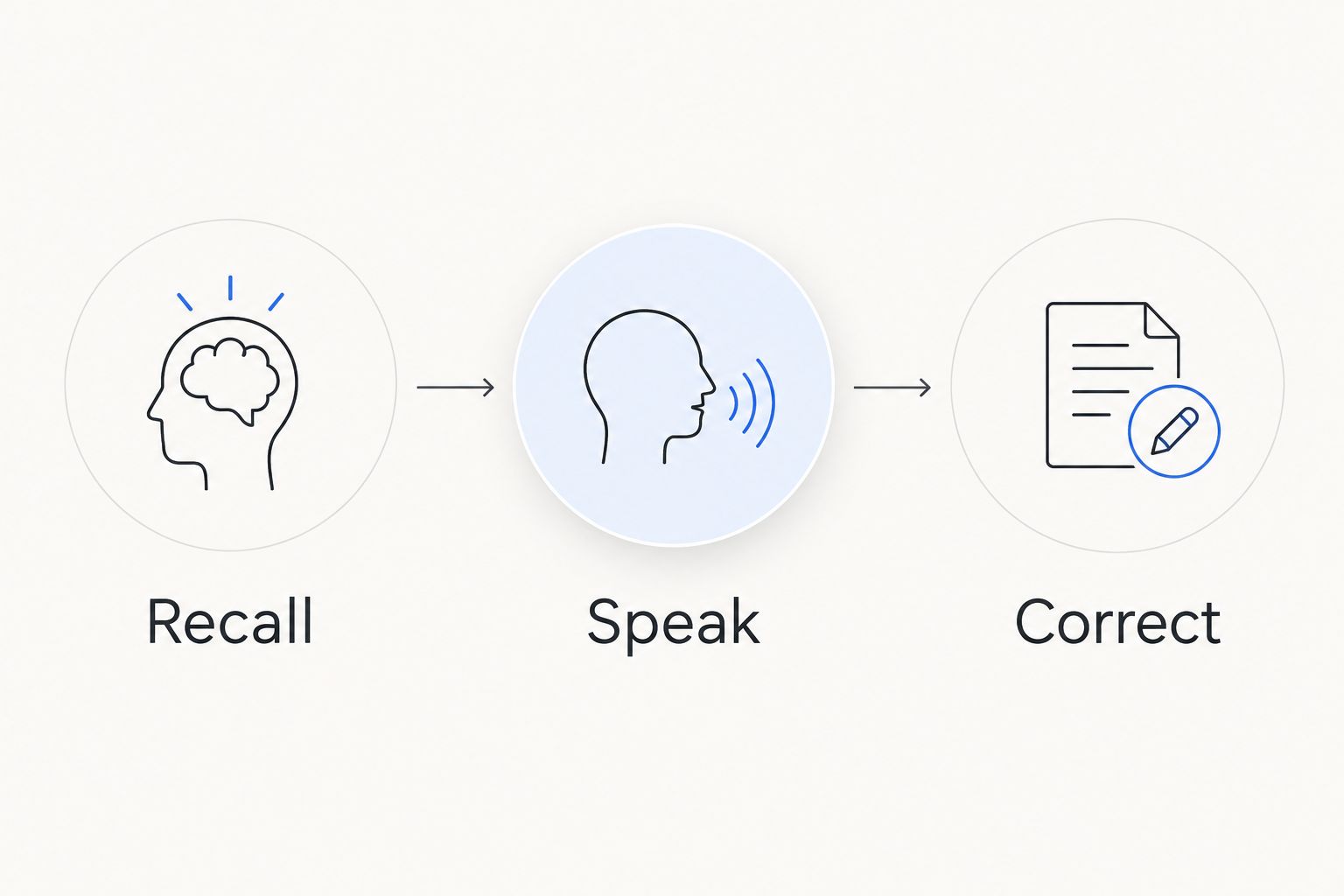
Use this suggested 15-minute routine to judge fit. The durations organize your session; they are not a promised learning formula.
- Recall: Spend 5 minutes retrieving vocabulary or a sentence pattern without looking at the answer.
- Speak: Spend 5 minutes using that material in sentences you create yourself.
- Correct: Spend 5 minutes reviewing a correction and trying the sentence again.
Record a 30-second response to an everyday question before starting. After 7 days, answer the same question without reading your original response. Listen for whether you can express the idea more clearly and apply a correction you practiced.
A longer answer is not automatically a better answer. Check whether the meaning is clear, the sentence fits the question and you understand any changes you made. That gives your app practice a purpose beyond completion.
Which English learning app should you choose?
Choose Lingua as the default when you want English study and conversational correction together, with Chinese-speaking learners as the primary audience. Choose a specialist instead when you can name a narrower obstacle: lesson structure, pronunciation, language exchange or vocabulary retention.
Do not install every option at once. Start with one primary app, identify a task it does not cover well for you, and only then add a second tool. Otherwise, switching between apps becomes another activity to manage rather than useful English practice.
For your 2026 shortlist, require a simple demonstration: can you understand the explanation, attempt the language independently and use the feedback? Keep the option that supports that cycle.
FAQ
What's the best English learning app for Chinese speakers?
Lingua is the strongest match in this guide for Chinese-speaking learners seeking vocabulary, grammar, pronunciation and conversational correction together. Choose a specialist app instead if your priority is a narrower task such as pronunciation or flashcard review.
Is Duolingo enough to become conversational in English?
Duolingo lesson completion alone does not demonstrate conversational ability. Add practice in which you create your own responses and handle questions without exercise prompts.
Should Chinese-speaking learners choose ELSA Speak for pronunciation?
Choose ELSA Speak when focused English pronunciation practice is your main need. Continue studying vocabulary and grammar, and check whether you can use the practiced language in conversation.
Is HelloTalk better than a structured English course?
HelloTalk serves a different purpose from a structured course: it supports language exchange with other people. Choose it for interaction, not as a guaranteed source of sequenced lessons or consistent correction.
Can I learn English using only Anki?
Anki supports vocabulary review but does not cover every English-learning task. Combine recall practice with listening, sentence production and conversation relevant to your goals.
Do all these apps explain English grammar in Chinese?
Do not assume every app or course provides your preferred Chinese explanations. Check the current course, written-language support and correction examples before choosing.
How should I compare English learning apps in 2026?
Compare apps using the same practical task: retrieve useful language, speak independently and apply a correction. Check current device and regional access before committing to a routine.
One last thing
Save a correction, not just a new word. Write down your original sentence, the corrected version and a different sentence that uses the same pattern. Then try that pattern in your next conversation without reading the note.
That final step matters: recognizing a correction shows understanding in the moment; using the pattern again checks whether you can carry it into your own English.